Music
Music is a universal language that embodies one of the highest forms of creativity. Our curriculum aims to provide all pupils with a high-quality music education that engages and inspires children to develop a love of music and their talents as musicians, and so increase their self-confidence, creativity and sense of achievement. As pupils progress, they should develop a critical engagement with music, allowing them to compose, and to listen with growing appreciation.
Intent
At our school, the intent of music teaching is to engage and inspire all children to develop a personal life-long love of music, increase self-confidence, imagination and creativity.
Children will develop an understanding of what music is through listening and appraising, singing, playing, evaluating, improvising and composing across a wide variety of historical periods, musical genres and traditions, in order to gain a sense of personal development and achievement.
Charanga’s English Model Music Curriculum Scheme is aligned with the National Curriculum for Music and the non-statutory Model Music Curriculum (MMC) Guidance published by the DfE in 2021.
Implementation
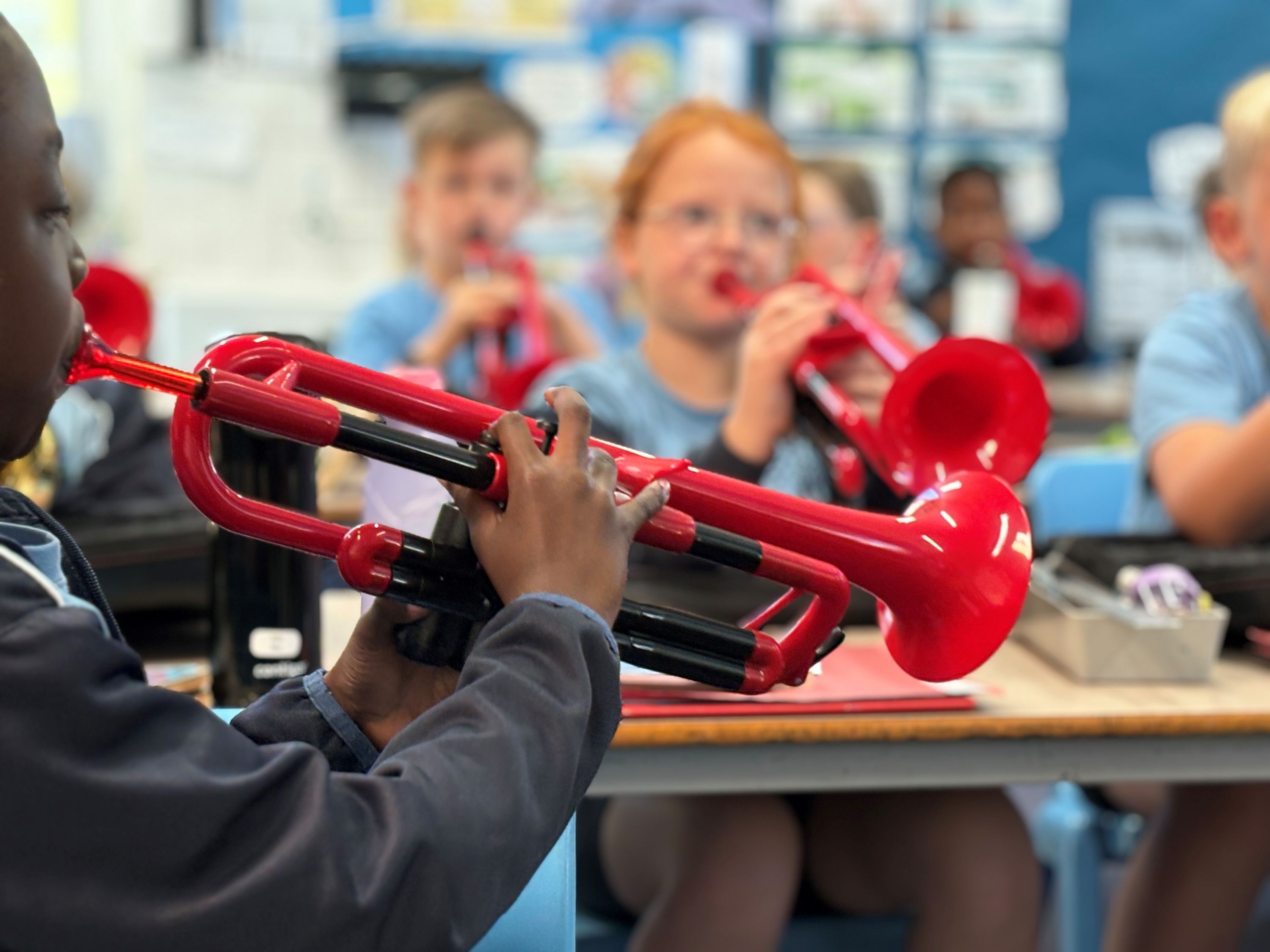
The music curriculum ensures students sing, listen, play, perform and evaluate. This is embedded in the classroom activities as well as the weekly singing and class assemblies, performances, and the learning of instruments that include strings, wind and pitched and unpitched percussion. In doing so, pupils understand the different principles of each method of creating notes, as well as how to read basic music notation. They also learn how to improvise and compose, focussing on the dimensions of music, which in turn feeds their understanding when listening, playing or analysing music.
Singing lies at the heart of good music teaching, and we focus on developing the children’s ability to sing in tune and with other people, as well as learning about the structure and organisation of songs. The elements of music are taught in classroom lessons so that children are able to use musical language to dissect it and understand how it is made, played, appreciated and analysed.
We subscribe yearly to an online scheme called Charanga and use this for the main delivery of our lessons. The strands of musical learning presented within the week-by-week lesson plans and the on-screen resources, are part of the learning spiral and are visited from EYFS to Upper Key Stage 2. Over time, children can both develop new musical skills and concepts, and re-visit as part of their progression.
Impact
The impact of our music curriculum is that pupils develop confidence, creativity and a lasting love of music. Through rich musical experiences, children build an affinity with music by exploring, listening to and appreciating a wide range of styles and traditions. They are encouraged to aspire as musicians, developing resilience, curiosity and confidence through singing, performing and creating music together. As they progress, pupils achieve by developing secure musical knowledge, skills and understanding, enabling them to perform with confidence, express themselves creatively and take pride in their musical journey.
Types of Knowledge
The Music research review states that pupils learn in Music by acquiring three types of knowledge: Tacit knowledge, Procedural knowledge & Declarative knowledge.
|
Tacit knowledge (‘knowing intuitively’) |
Procedural knowledge (‘knowing how’) |
Declarative knowledge (‘knowing that’) |
|
Much of the knowledge gained in music learning is gained through experience with music and informal listening, not through direct instruction. Tacit knowledge can be both substantive and disciplinary and includes: Developing a natural sense of rhythm and melody, demonstrated by an ability to clap along to the pulse of the music. Learning how to hold instruments through hands-on experience. Understanding pitch and tone in singing through practice and imitation. Instinctively move to music, showing an understanding of rhythm and expression through their bodies. Understanding that music can evoke feelings by listening and reacting to different types of music. Pupils have many opportunities to develop this tacit knowledge throughout the curriculum. In EYFS (Reception) and KS1, pupils are encouraged to explore instruments, sound and emotions. As they develop musically, this tacit knowledge is refined with more explicit instruction. Tacit knowledge is most often developed in the ‘Listening and evaluating, ’Creating sound’ and ‘Improvising and composing’ strands, where pupils develop an intuitive understanding of music. |
Playing music is a skill; to be able to competently perform that skill, musicians undoubtedly have many elements of procedural knowledge, including: How to hold the instrument correctly. How to produce different sounds with the instrument. How to read the notation in front of them. How to play a melody in time. There is a crossover between tacit and procedural knowledge. While some procedural knowledge may be acquired instinctively, it may also require refinement. Procedural knowledge is most often developed in the ‘Creating sound,’ ‘Improvising and Composing’ and ‘Performing’ strands. |
This is the factual information and concepts pupils learn that can be clearly stated or ‘declared’. It includes: Being able to name musical instruments and their characteristics. Understanding musical terminology, such as pitch, tempo, rhythm, etc. Naming symbols used in musical notation and what they represent. Knowing about musical styles and genres and their cultural and historical background. Knowing about significant figures in music. This type of knowledge is most often developed in the ‘Listening and evaluating and ‘Notation’ strands. |
Enrichment and wider opportunities
We have an extracurricular school choir, iRock School of Music, and peripatetic individual music tuition on offer to work with children wishing to learn and develop their skills playing chosen instruments.
Biennial specialist music days are also booked, such as djembe drumming or steel pan days, to enhance each pupil’s experiences.